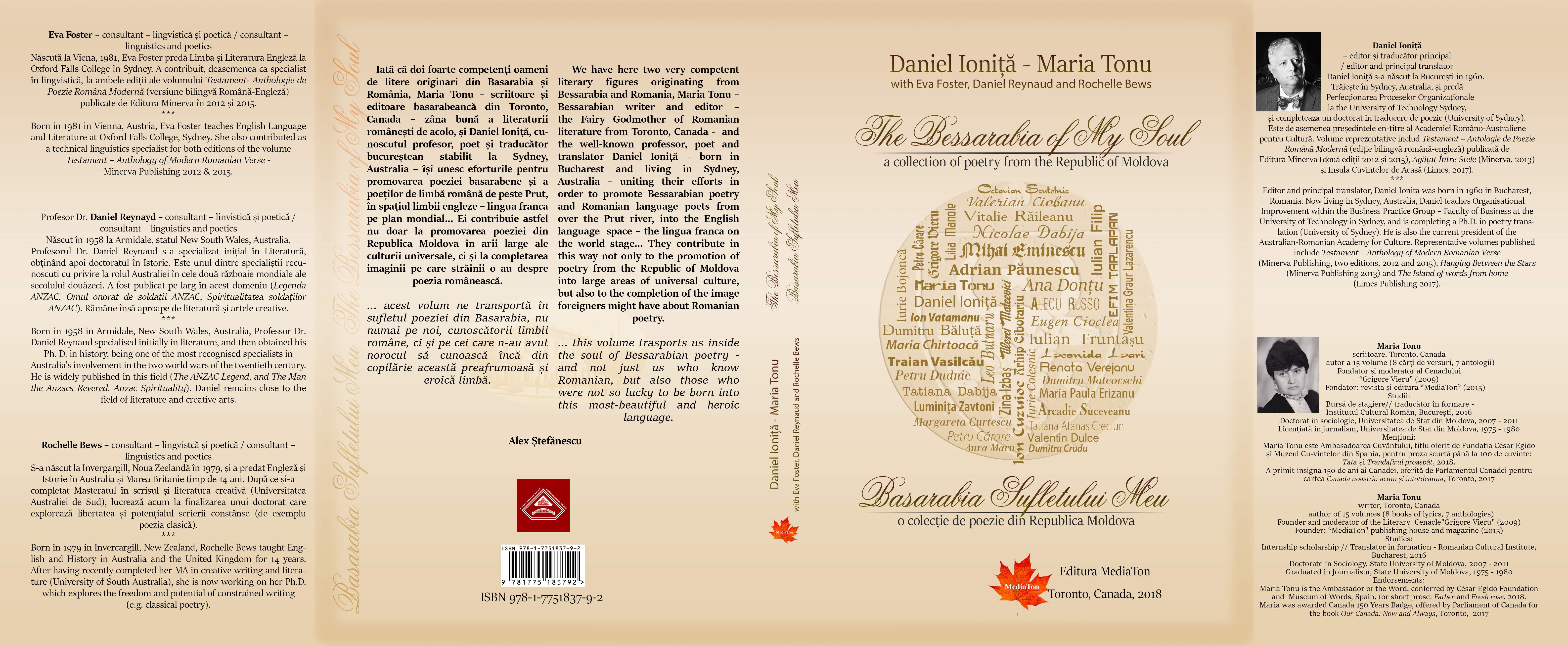
The Bessarabia of My Soul – a collection of poetry from The Republic of Moldova
Coordinators: Daniel Ioniță, Sydney, Australia and Maria Tonu, Oakville, Ontario, Canada.
Published by Mediaton, 2026
https://mariatonu.wordpress.com/mediaton-publishing-house/
This volume also contains a selection of poems
translated by the authors for
Testament – Anthology of Modern Romanian Verse
– bilingual edition Romanian/English
published by Minerva Publishing House in 2015
and was realized with the support of
Australian – Romanian Academy for Culture.
Preface:
A union of competence,
good taste and enthusiasm
– in the service of Bessarabian poetry
Two very competent literary figures from
Bessarabia and Romania, Maria Tonu –
Bessarabian writer and editor living in
Toronto, Canada, and Daniel Ionita,
university lecturer, poet and translator
originating from Bucharest and settled
in Sydney, Australia – have achieved
something our politicians from both the
Eastern and Western sides of the Prut river
could not: to unite their efforts for the good
of Bessarabia. Specifically, for the promotion
of Bessarabian poetry and of Romanian
language poets from there – into the English
language space – the lingua franca in today’s
world. And they do this with
professionalism, competence, good taste and
enthusiasm.
If someone would have asked for a list of
translators capable to translate Romanian poetry
from Bessarabia in English, I could have given them
a hundred names. We have an army of good
translators, with whom we could conquer the world
– culturally – if we didn’t discourage them by
paying them poorly for their work and not even
offering them a moral reward (there are literary
critics who, when they comment on a book in
translation, make no reference to the translator!).
But had I been asked for just one single name of the
translator I consider the most appropriate for such
and enterprise, I would have come to Daniel Ionita,
without a doubt, who not only has the talent, the
vocational intellectual training, but also the
enthusiasm and the means necessary (through the
Australian-Romanian Academy for Culture which he
leads) for promoting Romanian literature around the
world.
The impressive collection of Romanian poetry
from all eras, Testament, which appeared in a few
successive editions (Minerva Publishing) all
bilingual, enjoyed and continues to enjoy a resounding success, fed by admirers, but also by
detractors, who are never far away where we talk
about a valuable endeavour – easily generating envy.
The new volume in front of you is in the same
vein – The Bessarabia of My Soul – a collection of
poetry from the Republic of Moldova. Edited by
Maria Tonu and Daniel Ionita, translated by Daniel
Ionita, assisted by Eva Foster, Daniel Reynaud and
Rochelle Bews – who also cooperated to realise the
exceptional series of volumes Testament –
Anthology of Modern Romanian Verse (bilingual
version) mentioned above – this is an important
cultural work, vital I could say, for the poetry of the
Bessarabian space. Moldova and Bukovina, both
those from the interior and the exterior of Romania’s
current borders, ancient Romanian territories, have
proven during their history a true vocation for poetry
– to certify this we need only mention Mihai
Eminescu, national poet of both these spaces – but
the current volume will reveal the existence of
many, many more. The fragments of these historical provinces
which have abusively been integrated in the
componence of the USSR, have been subjected, for
about half a century, not only to a process of
“communistisation”, but to also one of forced de-
nationalization, including the disfiguring or the
Romanian language through adopting the Cyrillic
alphabet (a functional and harmonious one for
writing in Russian, but alien in the Romanian
language space) and the invention of a grotesque
and deceiving glottonym: the Moldavian language.
Despite that, even in this space of
ostracization for the Romanian language, poetry did
not cease to exist and evolve. After 1989, when we,
those living in Romania, were no longer forbidden
to communicate with the Bessarabians, we had a
true revelation, discovering what great poetry had
continued to be written in the Republic of Moldova.
We become joyful when we discover some new
poem of Tudor Arghezi or Nichita Stănescu. In the
same way, but on a much larger scale, after 1989
we discovered thousands of new great poems (for us) of Romanian poets living on the other side of
the Prut river. We had a celebration.
Daniel Ionita, the well-known poet and
translator, assisted by the Fairy-Godmother of
Romanian literature from Canada, Maria Tonu,
explores and emphasizes the value of this recently
recovered chapter from the history of Romanian
literature. They contribute, not only to the the
promotion of Bessarabian poetry in large areas of
universal culture, but also to the completion of the
image foreigners might have about Romanian
poetry.
It is truly remarkable the large scope for good
taste and competence afforded by Maria Tonu and
Daniel Ionita in approaching the handling this
poetic material: the experienced Romanian poet and
translator from Sydney and the Bessarabian writer
and editor from Toronto, do not discriminate
between classics and romantics, between modern
and post-modern, between narcissists and militants,
between intimists and visionaries.
This collection represents all directions of
Romanian poetry written in Bessarabia. And the translator does not hesitate to reconstitute in English
the enunciations, solemnly-sententious, for
Eminescu’s “Gloss”, or the lamentation full of
dramatism from “Bessarabia with Sorrow” of
Grigore Vieru, or the paradoxical ideas constructed
in the poetry of Leo Butnaru, or the high-
emotionalism erupting with light from the well-
known poem “All the Wattle Trees are Crazy” by
Arhip Cibotaru (put to music and electrifyingly
interpreted by Tudor Gheorghe). I was especially
impressed by the way it sounds – like the tolling of a
bell – in the English translation of Daniel Ionita, the
poem-in-prose The Hymn of Romania by Alecu
Russo: „Wake up Romanian land! vanquish your
pain; it is time to raise up from your slumber, you
seed of this world’s kings!… Are you perhaps
waiting to be resurrected, so that your ancestors rise
from their tombs? Verily, verily they have risen, and
you have not noticed them… They have spoken and
you have not heard… Brace yourself, seek and
listen… The day of justice draws near… all the
peoples have been rumbling… as the day of
salvation has begun…” We, the Romanians from Romania, have suffered
during communism a true tragedy, with millions put
in jail, killed, or expelled from the country for
political reasons, yet we had never been interdicted
the use of our language, the essence of our identity.
To the Bessarabians this was forbidden. The natural
act of the mother-tongue had become in many cases
a heroic act. So, from the poets of Bessarabia, true
heroes have emerged, unto the cause of the
Romanian language. One of these, Dumitru
Matcovschi, represented in this volume, dedicated
an ode to the Romanian language (as did Alexei
Mateevici, as did Grigore Vieru, as did others), and
not through some external rhetoric, but with an
existential tremor transmissible to us:
It is ours, our language,
and one with it, we form a nation,
like stars
within the skies
are stars
with their eternal light creation.
It is ours, our language
together we the earth engrave
like the big sea
it is a sea
its waters – an eternal wave.The writers from the Republic of Moldova have
things to learn from us, but we also can learn from
them – for example this appreciation of the
Romanian language (to which, lately, we no longer
pay the required attention).
Similarly, we can learn patriotism, which we
repudiate openly today, mistakenly confusing it with
jingoistic demagogy. Our only recent poet (born,
possibly not by chance, in the Republic of Moldova)
who never hesitated to declare his love for all things
Romanian, Adrian Păunescu, is regarded maliciously
in Romania (even after his death) and with
admiration and love in Bessarabia. We find him in
this volume with a simple and moving poem,
unknown or maybe just forgotten – still sang here
and there by Mădălina Amon – gripping our soul:
“Though people living in these parts
It seems that God abides
As firewood across their yards
they bring with little strides.
And, Eden-like, they peace convey
in all their rites and ways
When for their horses bring some hay,
and for their sheep some maize… In all, this mystery abides,
and lingers through their hearth;
Three parts of them in heaven lay,
and just one part on earth…
And all the while with growing hope
they fan their fire bright
For God, when visiting their dreams,
to warm Himself at night.”
Even though I did not enjoy a childhood in the
country-side, I recognise this ancestral world,
evocated with such nostalgia by Adrian Păunescu –
evocation which could apply easily to any
Romanian village, whether to the West or to the
East of the Prut river. Daniel Ionita forwarded this
poem for the English language readers and I am
convinced that they will also be jolted a bit, while
reading it, by some memory from their own
ancestral past.
Displaying democracy and comprehensiveness
– which had as unique criteria for selecting the
authors for just the literary value of their work – the
editors and the translation team made room in the
book for poets of all generations. The generation
identified by us as “of the seventies” is represented by Nicolae Dabija, Dumitru Băluță, Eugen Cioclea,
Iulian Filip, Leo Butnaru, Leonida Lari, Arcadie
Suceveanu and others, the “eighties” by Maria Tonu,
Maria Chirtoacă, Valerian Ciobanu, Renata
Verejanu, Vitalie Răileanu, Tatiana Afanase-Creciun
and others, the “nineties” by the likes of Dumitru
Crudu, Traian Vasilcău Iulian Fruntașu, Tatiana
Dabija etc. Surely this partition into decades is only
conventional, its only aim being that of making
visible the succession of newer waves of poets –
proof of the vitality of poetry written in Bessarabia.
The selection reaches to authors only relatively
recently born, but well developed as poets: Ana
Donțu (1985), Aura Maru (1990), Ion Buzu (1990),
Maria Paula Erizanu (1992).
The collection ends with the
heartrending poem “Letter to Bessarabia”
written by Daniel Ionita himself:
“Your blood and your tears flow in deep rivers,
as if bursting from the pierced thigh of Christ,
himself crucified, innocent, just like you.
They trickle on your hills and fields
from Bălți to Orhei, Dolna and Slobozia, through all your villages with autumns and springs
shackled still,
flowering from longings into poems with scents of
freedom.
From Great Stefan,
who sacrificed his whole life for faith and land,
from Brave Michael, who, for but a moment,
fulfilled a dream which still troubles us –
you have remained there, between the Prut and the
Dniester,
with your daughters and your sons,
these saints whom I call sisters and brothers.”…
What else can we say? In fact, nothing more –
all we must do is simply read this book, which
transports us into the world of Bessarabian poetry,
only this time not just us, those who know
Romanian, but also those who were not so lucky to
be born into this most-beautiful and heroic language.
Alex Ștefănescu
– literary critic and historian –

 mariatonu